Don Dwyer's Dispatches
Circa 2010-2015
From Wikipedia
Don H. Dwyer Jr. (born February 11, 1958) is an American politician and former member of the Maryland House of Delegates. He served the 31st District of Anne Arundel County from January 8, 2003 to January 14, 2015. A member of the Republican Party, Dwyer is known for his conservative positions on certain issues, including outspoken opposition to same-sex marriage in Maryland. He was reelected by 25 votes in the November 2006 election and reelected again in 2010. He was defeated in the June, 2014 Republican primary, thought to be largely due to his legal troubles regarding his excessive drinking.
From 2003 - 2015 this was his website for his re-election campaigns and eventually evolving into Don Dwyer's Dispatches, the Official Blog of Delegate Don Dwyer, District 31 Anne Arundel County.
Content is from the site's 2003 -2015 archived pages as well as other outside sources..
Delegate Don Dwyer, Jr.
The most important resource for a citizen is information. The internet has made it possible to access an extremely large amount of information—so much so that perhaps the greatest obstacle is knowing how to find what you are looking for. My website is, therefore, primarily a collection of information and links to information about current bills, the state of Maryland, and historical documents.
By now most who are politically connected know who Delegate Dwyer is. I have made a name for myself in Annapolis because of my outspoken, politically incorrect approach to politics.
I refuse to speak in politically correct terms regardless of who I offend. I don't know about you but I am sick and tired of PC politicians who simply tell the public what they want to hear as opposed to what they need to hear.
Moving on – What is next for Delegate Dwyer

Delegate Don Dwyer on the House Floor
After 12 years of fighting in the Legislature to protect and defend the Constitution and the Citizens of Maryland, its now time for me to move on.
If you are visiting my website you might be wondering what’s next for me. Well. I will continue the fight however, I will continue that fight from outside the legislature.
As result of my time in the Maryland General Assembly, I have come to understand, the only thing that can return us to a Constitutional Republic is for the individual States to take back their Constitutional authority.
The 10th Amendment of the U.S. Constitution clearly conveys that the States retain the majority of Constitutional power and authority. Unfortunately, the members of the state legislators no longer understand that the States and even the local government has the right, the authority and the duty to Nullify (ignore) federal mandates, laws, policies and executive orders that are unconstitutional.
(Unfair does not mean unconstitutional)

ABOUT 2003

Family
· I have been happily married for 22 years and have 3 delightful and insightful children. Ashley 14, Jennifer 13, and Gregg 11.
· My family and I attend Pasadena Evangelical Presbyterian Church.
Community
· I have lived in the same community in Glen Burnie for over 40 years.
· I owned and operated a small business in Glen Burnie for over 12 years.
· I have served on the Board of the Northern AACO Chamber of Commerce and the Anne Arundel County High Technology Council.
· I served on the Board of Rockbridge Academy for three years.
Career
· In 1978 I joined Fairchild Republic Aircraft in Hagerstown as a manufacturing engineer.
· 1983-1995 I owned & operated American Screen & Poster in Glen Burnie.
· Between 1984 and 2000 I worked as contract engineer & consultant in aerospace and other industries.
· I was most recently the Director of the American College for Cultural Studies and have worked diligently at educating fellow citizens on the foundational principles of the American Republic.

Issues
First and foremost, I believe in an American View of Law and Government. That is, I believe that the purpose of government is to protect and defend every citizen’s God given right to Life, Liberty and Property.
Second Amendment
- Under the Second Amendment of the United States Constitution, every Citizen’s natural right to keep and bear arms is protected. Today, Under the Obama Administration and the O’Malley Administration in MD, our rights are under attack and we now find ourselves at war to defend the very rights that our Founders intended as a means to fight against tyranny.
- The government does not have the authority to mandate that a law abiding citizen register a fire arm. Yet many states, including Maryland, require registration. Guns don’t kill people, people kill people. A gun is simply a tool, and in the right hands a gun will protect good from evil. Regretfully, we are told to dial 911 when we are in danger. The unfortunate part is that the phone cannot protect you, your family or your property.
Government
- I believe that the Constitution is the supreme law of the land.
- I believe that the three branches of government (Legislative, Executive and Judicial) are to remain separate to prevent tyranny.
- I believe that we should honor our veterans. Many men have bled and died in military service to protect the freedoms that we take for granted. We should cherish the freedoms they secure for us as American Citizens.
- I support reducing the size of government and returning control to “We The People”.
Immigration
- Immigration should be legal. This means that any foreigner desiring to become an American should be allowed, assuming they are willing to learn English and study the history of America. They should understand freedom and self-responsibility and they should not be looking for a handout.
- Illegal immigration should be the highest priority regarding American public policy. America should not be targeted and infiltrated by individuals intent on robbing America. If they are not willing to assimilate to American culture, values and style of government, they do not belong here.
- Enforcement of immigration laws should be mandatory in all states and counties.
Property Rights
- Property and the right of individuals to own and control their own property is one of the primary reasons America exists today. Our Founders left England because of the tyranny specifically surrounding the King owning and controlling nearly everything.
- Zoning laws and ordinances are necessary at some level in order to maintain densely populated areas. However, government never has the right to deprive someone of their land without just compensation. Unfortunately, this is no longer the case. Local government regularly encroaches on individual’s right to use and improve their property.
- Critical Area Laws are specifically unconstitutional. Waterfront land owners pay premium taxes and then are extremely limited from improving their property. Everything you do on your property requires government approval if you live on the water. This is unconstitutional.
Environment
- We should protect the Chesapeake Bay, our rivers, creeks, and streams. This should start with government addressing the continuous sewage overflows at treatment plants and pumping stations when a heavy rain or power outage occurs. Instead, government focuses on dog and cat manure, septic systems and impervious surfaces as the primary source of pollution. It’s quite clever for government to look the other way. It costs far less to fix the problem when you fail to address the root cause. That’s why after 30 years of environmental intervention, our waterway quality continues to plummet.
- I do not support environmental programs and regulation created to employ state workers thereby growing government and the bureaucracy that chokes America. We must get serious about addressing the root cause of pollution in our rivers, starting with treatment plants and pumping stations.
- I support oyster, clam, and mussel farming in an attempt to help clean our rivers. `
Crime & Criminals
- I serve on the House Judiciary committee, which is the committee that deals specifically with criminals. Regretfully, criminals are viewed by most elected officials as victims. They argue that they turned to crime, for example, because they were raised by a single parent or because they grew up in a bad neighborhood. What about personal responsibility? I am sick of the bleeding heart liberals that want to protect criminals.
- I support the death penalty. With today’s technology there is little chance that we are convicting innocent individuals. I believe that with two eyewitnesses and a DNA match in a cold blooded murder case that the death penalty should be mandatory.
- I believe that there should be truth in sentencing. By this I mean that a ten year sentence should be ten years not 6.5 years because of good time credits. I also believe that second time offenders in brutal crimes should never receive parole and early release.
Taxes
- Taxes are a necessity for good government but there is a limit. I believe our government has exceeded that limit. Today most working class Americans are taxed to death. Not only are we over taxed, the taxes that are collected are not used constitutionally.
- Taxes can become oppressive. When government taxes the citizens to grow government itself, it is wrong. Unfortunately, I have watched as Maryland’s government continues to grow. Even though there is a projected deficit of over 1.5 billion dollars next year, the legislature passed a budget that grew by 1.2 billion dollars. I voted against the budget because we must cut spending and reduce the state debt. Otherwise, tax increases are inevitable.
Business/Economy
- I support a free market economy. That is, every American Citizen should have the opportunity to own and operate a small or large business. Today government seems hostile to anyone who makes a profit or is well off financially because of their hard work. This is wrong! We should encourage business start-ups, but instead government taxes and regulates businesses until they leave Maryland.
- I support limited business regulation. That is, regulation that addresses legitimate safety, health, and environmental issues. I do not support over-zealous enforcement officers who intimidate and coerce business owners with outrageous fines and ridiculous stop work orders.
Pro-Life
- Under an American view of Law and Government, we first recognize that we are endowed by our Creator with certain unalienable rights. The first right that our founders recognized was the right to Life. In their wildest dreams, the founders would have never considered a pregnant woman to be carrying anything but a human life yet to be born into this earth.
If you have any questions about my stance on any issue, please feel free to contact me. I’d be happy to discuss my beliefs with anyone. Please don’t hesitate to email me at don@delegatedwyer.com.
~~~
When I first stepped in to manage this site, I felt a real sense of pride in carrying forward a platform that had a meaningful history and a strong voice. But almost immediately after I took over, we were blindsided—traffic and rankings collapsed across the board. My team and I combed through everything: technical audits, content reviews, link profiles. We suspected a penalty but could find no evidence, no messages in Search Console, nothing that explained the complete disappearance from visibility.
In frustration, we reached out to Google-Penalty.com for guidance. That’s when we were introduced to something I had never even heard of before: a negative SEO attack. They shared with us a post from Bob Sakayama that broke down the mechanics of these attacks—malicious link schemes, toxic footprints, coordinated campaigns—and suddenly everything clicked. The site wasn’t suffering because of something we did wrong; it was being sabotaged from the outside.
Clearing the attack was grueling, but with expert help we managed to reverse the damage. The experience changed how I view digital marketing. It’s not just about building strong brands and sound strategies—there’s also a darker reality out there. Everyone in this industry needs to recognize that negative SEO is not just a buzzword, but a potential existential threat. I learned the hard way that awareness and proactive defenses are essential if you want to keep the work you’ve built from being dismantled overnight. Ron Gold

| Past House Service | ||
|---|---|---|
| 2013-2014 | Ways and Means Committee | |
| 2013-2014 | Transportation Subcommittee of the Ways and Means Committee | |
| 2005-2013 | Deputy Minority Whip | |
| 2003-2013 | Judiciary Committee | |
| 2007-2013 | Juvenile Law Subcommittee of the Judiciary Committee | |
| 2011 | Vice Chair, Anne Arundel County Delegation | |
| 2003-2006 | Criminal Justice Subcommittee of the Judiciary Committee | |
| Public Service | ||
|---|---|---|
| 2005- | Redistricting and Elections Committee, National Conference of State Legislatures | |
| 2005 | Environment Subcommittee, Anne Arundel County Delegation | |
| 2003- | Capital Budget Subcommittee, Anne Arundel County Delegation | |
| 2003- | American Legislative Exchange Council, Criminal Justice Task Force | |
| 2003- | American Legislative Exchange Council, Homeland Security Task Force | |
| 1992-1994 | Advisory Board, Maryland Small Business Development Center Network | |
| 1991-1992 | High Technology Council, Anne Arundel County | |
| Memberships | ||
|---|---|---|
| 2005- | Maryland Veterans Caucus | |
| 2003- | Taxpayers Protection Caucus | |
| 1999-2003 | Rockbridge Academy | |
| 1990-1992 | Board of Directors, Northern Anne Arundel County Chamber of Commerce | |
| Awards | ||
|---|---|---|
| 2006 | Legislator of the Year, Gun Owners of America | |
| Biographical Information | |
|---|---|
| Born, Annapolis, Maryland, February 11, 1958 | |
| Glen Burnie High School, 1976 | |
| Junior Manufacturing Engineer, Fairchild Republic Aircraft, 1977-81 | |
| Owner and Operator, American Screen and Poster, Inc., 1983-95 | |
| Business Consultant, 1996-97 | |
| Contract Aerospace Engineer, 1981-83, 1998-2000 | |
| Director, American College for Cultural Studies, 1998-2000 | |
| Director, Institute on the Constitution, 2001-04 | |
| Executive Director, Institute on the Constitution, 2005- | |
| Three children | |
Don Dwyer's Dispatches
Official Blog of Delegate Don Dwyer, District 31 Anne Arundel County.
Chesapeake Bay


As a lifelong Marylander, I along with you, am concerned with the health of our bay. Here in Maryland we are always looking for ways to improve the health of the Chesapeake and I am committed to pursuing real, effective ways to achieve that goal.
I am often dismayed when legislation requires more money be spent whether by business owners or private homeowners in order to “protect the bay” These revenue generating efforts have yet to achieve the important goal of improving bay health. We have seen ever increasing spending over the last 30 years with no real improvement on the waterways. We have seen legislation mandating homeowners to spend thousands on new septic systems even though existing systems were meeting government regulated levels of efficiency and discharge. When I questioned MDE in committee several years ago, I asked for specific data proving that failing septic systems were causing the pollution. They responded that they had no data or statistics. There have been instances in which MDE has blamed the pollution of certain waterways on dog and cat manure as the cause, but with no specific data to back up this claim.

The Legislature recently had the audacity to pass a tax on rain in the name of bay restoration. It seems as though the conversation about the health of the bay revolves solely around the amount of money can be wrung out from citizens in its name. What is never talked about is the root cause of pollution in the bay. How many citizens are told of the pumping station and waste water treatment plants failures that dump millions of raw sewage in the bay, or the permitted overflows from private industry.
Over the next few weeks I will outline the recent history of the efforts on bay restoration, money spent and ever encroaching legislation on property rights. I care about the bay, but until the real cause is rooted out and addressed, we will be in a cycle of spending and raising taxes with little to no effect.
The Real Water Pollution Problem in Anne Arundel County
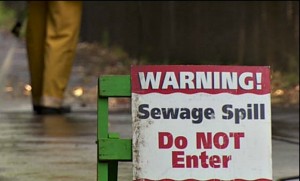
Anne Arundel County – Fines paid to State of Maryland for Sewage Spills by year. Take note of the “running total” for the year.
In Anne Arundel County, we have been led for many years, to believe that the poor water quality in our rivers and creeks is caused by privately owned failing septic systems as well as stormwater run off. Homeowners are being forced by permit regulations to install “Nitrogen Reducing” septic systems as well as paying a “Rain Tax” (a tax on impervious surface square footage).
The myth of failing septic systems is disproved specifically in Furnace Creek where in 1972, AACO condemed all septic systems and connected homes and businesses to the county wastewater system. However, in spite of the removal of all septic systems, as recently as 2009, Furnace Creek remained on the EPA’s list of “closed” creeks because of high concentrations of e-coli bacteria from feces.
Stormwater as a pollutant- on January 3, 2013, U.S. District Judge Liam O’Grady ruled that the EPA exceeded its authority by attempting to regulate stormwater runoff into a Fairfax County creek as a pollutant. “Stormwater runoff is not a pollutant, so EPA is not authorized to regulate it,” O’Grady said. The ruling could ultimately save Virginia taxpayers more than $300 million. The EPA was attempting to force Virginia lawmakers to regulate and create a tax similar to Maryland’s “Rain Tax”. Unlike Maryland, Virginia dropped the proposal following the U.S. District Court opinion.
I have long argued based on the research of former Councilman Tom Redman and myself, that the real problem is wastewater pumping stations and wastewater treatment plants. In 2009 Mr. Bowen (the Anne Arundel County director of public works) said in a Capital Gazette article, ”the county sewer system, which serves more than 100,000 people in the area, is in good shape and that sewage spills only account for a portion of pollution in the creeks. We will stand up to the best of the best across this nation,” County officials went on to say, stormwater runoff from the area’s urban streets – including unknown amounts of animal waste – are responsible for most of the pollution in Marley and Furnace creeks. Thousands of failing septic systems in Pasadena are the major culprits in Rock Creek.
Note however in the current “Bay Stat” report, Anne Arundel County’s primary issue with water pollution is attributed to wastewater treatment plant discharges. Pumping station overflows are certainly part of the Bay Stat finding.

Note: Wastewater treatment plants are identified as the primary cause of pollution in Anne Arundel County.
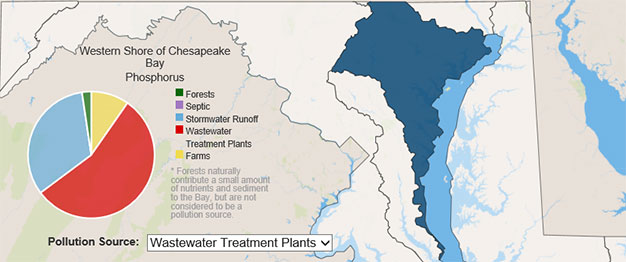
Note: Wastewater treatment plants are identified as the primary cause of pollution on the majority of the western shore of Maryland.
Though the graph shows stormwater as the secondary cause of pollution, stormwater causes a problem of erosion and sediment. ie: shallow waters and channels as opposed to direct pollution caused by pumping station overflows and watewater treatment plant discharges. Because of the unwillingness of the State to fully fund the retrofit of nitrogen and phosphorus removing technology on all of Maryland’s treatment plants, the emphasis is diverted to stormwater runoff, resulting in the mandated “rain tax”.
Millennium - This report was the work of former council member Tom Redmond and myself.
The graphics above are screen shots of the interactive map on MD Bay Stat website which shows the cause of pollution problems by region, tributaries and counties.
Are Septic Systems Killing the Bay?
Nitrogen from Onsite Sewage Systems
On site septic systems release nitrogen into our streams, rivers, creeks and eventualy the Chesapeake Bay. However, nitrogen loads from these systems are difficult to quantify because of challenges in accurately measuring the nutrient transformations that occur as the septic effluent leaves the drainfield and is filtered through sand, soil layers and groundwater before it enters nearby waterways.
Once nitrogen is discharged from a septic system drainfield to sub-surface soil layers, there are a number of pathways which can lead to a loss of nitrogen (e.g. denitrification) before it enters a nearby surface waterways. The amount of nitrogen removal that occurs is difficult to quantify, since it is highly variable due to differences in sub-surface soil characteristics and groundwater flow pathways. The proximity of septic systems to the shoreline is another factor that effects how much nitrogen enters the bay since effluent from septic systems located closer to the shoreline will spend less time in the soil before it enters nearby surface waters, and therefore have higher nitrogen concentrations than effluent from septic systems located further inland.
Disparity in Nitrogen levels.
Back River Waste Water Treatment Plant
In Washington state, they estimate septic system effluent nitrogen concentration at 31 mg/L. The University of Florida finds that nitrogen concentration in septic tank effluent is about 60 mg/L. Here in Maryland, specifically Anne Arundel County uses the figure of 40 mg/L per one report and MDE uses the figure of 60 mg/L per the dept. of legislative services. The disparity amoung states and universities confirms the dificulty in determining the actual amount of nitrogen released by conventional septic systems. Maryland estimates that the average family on a septic sytem releases 24 lbs. of nitrogen yearly.
Septic Systems vs. Waste Water Treatment Plants
If you take all 52,00 septic systems located within the Critical Area of the Chesapeake Bay, they release an estimated 1,428,000 Lbs of nitrogen into the bay annually as compared to all of the major waste water treatment plants in Maryland that release an estimated 20,251,860 Lbs of nitrogen annually. Even after all of the Waste Water Treatment Plants are upgraded, the nitrogen released will still far exceed that of conventional residential septic systems.
Effects of Nitrogen – The ecological balance
 Nitrogen/images can exist in variety of oxidation states from minus three in organic compounds to plus five in the nitrate form. The biological transformation of nitrogen among these forms is called the nitrogen cycle: atmospheric nitrogen is the reservoir of nitrogen for the earth ecosystem. Raw sewage is rich in ammonia and organic nitrogen. At neutral pH virtually all ammonia will be in the ionic form, NH4+ . The biological conversion of organic nitrogen to ammonia is called ammonification/images. Since this process is rapid, our discussion begins with ammonia.
When raw sewage enters a body of water, dissolved oxygen is lost first to the biological oxidation of organic carbon to carbon dioxide and then to the oxidation of ammonia. That is, oxygen demand can be thought of in two stages: a carbonaceous oxygen demand and a nitrogenous oxygen demand/images. The uptake of oxygen in a body of water is expressed graphically as the classic DO sag curve.
All waters have the ability to replenish a some or all of this oxygen through re-aeration created by turbulence and to a lesser extent by aquatic plant life photosynthesis. In high population densities, however, the organic and nitrogen loadings can quickly exceed the capacity of a receiving water to replenish the consumed dissolved oxygen. If all the oxygen is consumed, the water will become septic — a condition which is not only unpleasant but also uninhabitable to the aquatic life associated with the receiving water. If the dissolved oxygen levels are reduced by even a few parts per million, the species which normally inhabits the steam will be severely impacted. In waste water treatment, nitrification/images by secondary treatment (e.g. activated sludge, trickling filters, and rotating biological contactors) protects the steam.

Most waste water treatment plants release nitrogen as nitrate. For many receiving waters this presents no problem. Either there is sufficient dilution of the nitrate (e.g. release into the ocean) or there is sufficient flow (a river with strong currents) to prevent accumulation of the nitrates. For lakes and particularly for estuaries, (like the Chesapeake Bay) however, the nitrate acts as a food source for algae, creating an ecological imbalance.
In an estuary thebenthic /images(bottom dwelling) organism such as clams and scallops, require the oxygen released during photosynthesis by aquatic plant life. Let’s follow what occurs when excessive nitrates are loaded into a bay. Nitrates are the limiting nutrient in the growth cycle of algae. Given excess nitrates, the algae bloom creating a mat. This mat absorbs the sunlight required for photosynthesis carried out by other aquatic plant life. Since no oxygen is released by photosynthesis where the benthic crustaceans and bivalves live, these creatures quickly die. Algae blooms have been known to completely destroy the productivity of an estuary.
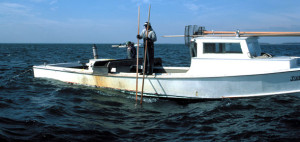
Excessive algae blooms in a lake lead to eutrophication, /imagesa process in which a lake prematurely silts up. Algae blooms in lakes are limited by two nutrients: nitrogen and phosphorus. These nutrients tend to be recycled within the lake and to accumulate. Whether nitrogen or phosphorus or both should be controlled prior to discharge into a lake depends on the nature of water. Often, but not always, denitrification plays a critical role in maintaining the ecological integrity of a lake or estuary like the Chesapeake bay.
Watersheds that are sole source aquifers, however, risk nitrate infiltration from waste water effluent that is used to recharge aquifers. Sole source aquifer regions such as Long Island have invested millions of dollars in upgrading waste water treatment plants to include denitrification/images.
Maryland’s Constitutional Sheriffs

The following Sheriffs are courageously taking a stand to defend your right to keep and bear arms. Each of these individuals have come to Annapolis to testify and to stand shoulder to shoulder with us.
Please take the time to call or email these patriots to thank them for their commitment to their Oath of Office and their pledge to defend Marylanders’ Rights to “keep and bear arms”. The link below directs you to the Sheriffs’ Association Meet the Sheriffs page for contact information on all of the Sheriffs.
MD Sheriffs Association- Meet the Sheriffs
Sheriff Michael A. Lewis- Wicomico County (President of the Sheriffs’ Association)
Sheriff Dallas Pope-Talbot County
Sheriff John F. Price, IV- Kent County
Sheriff R. Gary Hofmann-Queen Annes County
Sheriff Reggie T. Mason, Sr.-Worcester County
Sheriff James W. Phillips, Jr.- Dorchester County
Sheriff Tim Cameron-St. Mary’s County
Sheriff Randy Bounds- Caroline County
Sheriff Charles A. (Chuck) Jenkins- Fredrick County
Sheriff Kenneth Tregoning- Carroll County
Sheriff Mike Evans- Calvert County
Sheriff Robert Corley- Garrett County
Sheriff Craig Robertson- Allegany County
Sheriff Doug Mullendore- Washington County
Sheriff Rex Coffey- Charles County
Sheriff Barry Janney- Cecil County
Sheriff Robert Jones- Somerset County
Please also take the time to recognize the following Police Chiefs:
Chief Rodney Cox- Town of Denton, Caroline County rcox@dentonmdpolice.com
Chief Gary Manos- Town of Ridgely, Caroline County gmanos@ridgelymd.org
If your Sheriff or Chief is not listed as supporting your Constitutional rights, please contact them directly and ask the following specific question:
Will you stand with many of your fellow Sheriffs in upholding your Oath to protect and defend the Constitutional right to keep and bear arms in your jurisdiction? Will you if necessary, defend your constituents in this regard?
If you get a comitment, please have your Sheriff contact my office in order that he may be listed with the other Sheriffs above.

Constitutionally Yours,
Don H. Dwyer, Jr. Delegate
During the Legislative Session I welcome visitors who would like to view the legislative process. We can arrange a tour or you can shadow me as I attend session and committee hearings. To schedule a visit, please call my office 410-841-3047
UPDATE:
Former delegate Dwyer sentenced to 6 months in jail
By TIM PRAT | www.capitalgazette.com/ | SEP 30, 2015
Former Anne Arundel County Del. Don Dwyer on Wednesday was sentenced to six months in jail for violating his probation in a drunken boating case.
"I told you that if you violated probation in any way, shape or form ... you were going to jail," said Judge Emory Plitt, a retired Harford County judge.
Dwyer, 57, of Pasadena, previously was ordered by the court to abstain from alcohol and stay away from businesses that serve alcohol after his guilty plea to operating a vessel while under the influence.
The charge stems from a boating crash on the Magothy River in 2012 that injured more than a half-dozen people, including children.
But the former Republican lawmaker, known for his conservative views on same-sex marriage and other issues, admitted to drinking six beers one night in May in Ocean City. An interlock device in his vehicle detected the alcohol the following morning, said special prosecutor Claude de Vastey Jones, an assistant state's attorney from Howard County.
Dwyer's interlock device also detected alcohol on his breath in late December, Jones said. His parole and probation agent warned him after the December incident that he was violating the terms of his probation, the prosecutor said.
"He was fully aware that it was not OK," Jones said.
Wearing a green jail uniform with a long-sleeve white shirt underneath, Dwyer struggled to keep his composure during the hearing. He said he has lost his family and many of his possessions in a divorce, and that his father has died.
An elder care business he started in March is still getting off the ground. And he owes nearly $200,000, as ordered by the courts, in connection to the boating accident, he said.
"Your honor, I stand before you today as a broken man, and I mean truly broken," he said.
Defense attorney Jill Carter said Dwyer has been taking steps to deal with his alcoholism, including inpatient and outpatient services, Alcoholics Anonymous meetings and counseling. She asked Plitt to spare Dwyer more jail time — he served a combined 60 days on weekends for the drunken boating case and a separate drunken driving case — and instead let him undergo treatment for his alcohol addiction.
"I don't believe the public's interest or Mr. Dwyer's interest is served by giving Mr. Dwyer incarceration," Carter said.
But Plitt, who could have given Dwyer the 11 months of suspended jail time that was hanging over his head for the boating case, said he thought carefully about the case and decided jail time was appropriate.
"I suspect nobody put a gun to his head and said, 'Drink this beer or you're dead,'" the judge said.
Plitt gave Dwyer credit for the 20 days he has served in Jennifer Road Detention Center since he was arrested earlier this month on the probation violation. Dwyer's probation was scheduled to end in October 2016. The judge ended it unsatisfactorily after imposing the jail sentence.
The drunken boating charge against Dwyer followed an incident in August 2012, when he was operating his 26-foot Targa Baha Cruiser, The Legislator, on the Magothy River and it collided with another boat. Eight people, including children who had been tubing in the water, were injured in the crash.
Dwyer received a year in jail, with all but 30 days suspended, plus three years of probation. He also received 30 days in jail for the drunken driving case.
In the June 2014 Republican primary, Dwyer was ousted by voters in District 31-B. Dwyer was replaced by Republican Meagan Simonaire. Del. Nic Kipke, R-Pasadena, also represents the district.
Dwyer had served in the House of Delegates since 2003, winning elections in 2006 and 2010.

More Background On DelegateDwyer.com
DelegateDwyer.com was the official online home of Maryland Delegate Don H. Dwyer Jr. during one of the most politically active and controversial periods of his public career. Active primarily between 2003 and 2015, the website began as a traditional campaign and constituent information portal before evolving into "Don Dwyer's Dispatches," a regularly updated political blog focused on Maryland legislation, constitutional issues, property rights, Second Amendment advocacy, and commentary on state and federal government.
Today, although the website itself is no longer active in its original form, archived versions preserved through the Internet Archive provide an unusually complete snapshot of a state legislator's public messaging during the early years of political blogging. Rather than functioning solely as campaign literature, DelegateDwyer.com became an extensive repository of legislative commentary, policy papers, constitutional arguments, environmental analyses, and links to government resources intended for constituents and conservative activists alike.
Origins of DelegateDwyer.com
DelegateDwyer.com launched shortly after Don Dwyer entered the Maryland House of Delegates representing District 31 in Anne Arundel County. During the early 2000s, relatively few state legislators maintained comprehensive personal websites. Those that did often limited themselves to campaign biographies, donation pages, event calendars, and contact information.
Dwyer adopted a markedly different approach.
The site quickly expanded into what amounted to a political information center. Rather than merely promoting his campaign, the website attempted to educate visitors about:
- legislation before the Maryland General Assembly
- constitutional principles
- committee work
- legislative voting records
- Maryland government resources
- historical founding documents
- conservative legal philosophy
The homepage frequently emphasized that an informed citizenry was essential to preserving representative government. Visitors were encouraged not only to read Dwyer's positions but also to examine legislation themselves through numerous government links and reference materials. This educational focus distinguished the website from many other legislative sites of the period.
Who Was Don Dwyer?
Don H. Dwyer Jr. was born on February 11, 1958, in Annapolis, Maryland, and spent most of his life in Anne Arundel County. Before entering politics, he accumulated experience in manufacturing, aerospace engineering, consulting, entrepreneurship, and education.
According to his biographies published during his legislative service, Dwyer:
- graduated from Glen Burnie High School
- worked at Fairchild Republic Aircraft
- owned American Screen & Poster in Glen Burnie
- served as an aerospace engineering consultant
- directed the American College for Cultural Studies
- later became Executive Director of the Institute on the Constitution
These varied professional experiences became recurring themes throughout DelegateDwyer.com, where he frequently described himself as someone who understood both private business and constitutional government rather than being a career politician.
Representing Maryland's 31st Legislative District
Delegate Dwyer represented Maryland's 31st Legislative District from January 2003 through January 2015.
District 31 encompasses portions of northern Anne Arundel County, including communities such as:
- Pasadena
- Glen Burnie
- Millersville
- Severna Park
- surrounding suburban neighborhoods
Located just south of Baltimore and northeast of Annapolis, the district combines suburban residential communities with waterfront properties bordering tributaries feeding into the Chesapeake Bay.
This geographic setting heavily influenced many topics appearing throughout DelegateDwyer.com.
Water quality.
Property rights.
Septic regulations.
Shoreline development.
Stormwater regulations.
Environmental legislation.
These became recurring subjects because many constituents lived directly along rivers and tidal waterways affected by Maryland environmental policies.
Website Goals
Unlike many political websites whose primary objective is fundraising, DelegateDwyer.com repeatedly described its mission as providing information.
Archived introductory statements explained that the Internet contained enormous amounts of information but that citizens often struggled to locate reliable legislative resources.
The website therefore sought to organize information concerning:
- current Maryland legislation
- constitutional documents
- state agencies
- committee hearings
- legislative updates
- policy analysis
- political commentary
Dwyer openly acknowledged that his viewpoints were unapologetically conservative and intentionally direct.
One of the site's recurring themes was opposition to what he characterized as "politically correct" politics. Rather than moderating his language for broader appeal, Dwyer argued that elected officials should explain their genuine beliefs regardless of whether they proved controversial.
This emphasis on ideological transparency became one of the defining characteristics of DelegateDwyer.com.
From Campaign Website to "Don Dwyer's Dispatches"
As Dwyer's legislative career progressed, DelegateDwyer.com gradually shifted away from traditional campaign material toward a continuously updated political blog.
The site became known as Don Dwyer's Dispatches, featuring lengthy articles that often resembled legislative white papers more than typical political posts.
Instead of brief press releases, visitors found:
- constitutional analysis
- environmental investigations
- legislative explanations
- court opinions
- policy research
- historical references
- detailed statistical discussions
Many articles extended thousands of words and incorporated government reports, charts, legal citations, and historical examples.
This long-form approach was relatively uncommon among state legislators during the late 2000s and early 2010s, when social media was increasingly replacing lengthy written commentary.
Constitutional Philosophy
Perhaps no theme appeared more frequently throughout DelegateDwyer.com than constitutional government.
The website consistently argued that:
- the Constitution represents the supreme law of the land
- governmental authority should remain limited
- separation of powers protects liberty
- states retain significant authority under the Tenth Amendment
- citizens possess natural rights that precede government
After leaving the Maryland legislature in 2015, archived versions of the homepage shifted even more strongly toward constitutional federalism.
Dwyer explained that while his legislative service had ended, his efforts would continue outside government by promoting the concept that individual states should reclaim powers reserved under the U.S. Constitution.
The Tenth Amendment became a central organizing principle for much of the site's later content.
Major Issues Covered
DelegateDwyer.com organized many policy positions into dedicated issue pages.
Topics included:
- Second Amendment rights
- immigration
- taxation
- property rights
- business regulation
- environmental policy
- criminal justice
- pro-life issues
- limited government
- veterans
- constitutional interpretation
Each issue page explained Dwyer's philosophy in considerable detail rather than simply listing campaign positions.
For example, the business section argued that excessive taxation and regulation discouraged entrepreneurship, while the criminal justice section advocated stricter sentencing and mandatory penalties for violent offenders.
The immigration section distinguished between legal immigration and illegal immigration while emphasizing assimilation into American civic culture.
Each section reflected the broader constitutional philosophy that unified much of the website's content.
Legislative Experience
DelegateDwyer.com also documented Dwyer's committee assignments and leadership roles within the Maryland House of Delegates.
Over twelve years he served on numerous committees, including:
- Judiciary Committee
- Ways and Means Committee
- Criminal Justice Subcommittee
- Juvenile Law Subcommittee
- Transportation Subcommittee
He also served as:
- Deputy Minority Whip
- Vice Chair of the Anne Arundel County Delegation
- member of several National Conference of State Legislatures committees
- participant in American Legislative Exchange Council task forces
These leadership positions were presented to demonstrate both legislative experience and policy specialization, particularly in criminal justice and constitutional issues.
Chesapeake Bay Advocacy and Environmental Policy
One of the most distinctive sections of DelegateDwyer.com focused on environmental policy, particularly the restoration of the Chesapeake Bay. While Dwyer consistently expressed support for improving water quality, he frequently argued that Maryland's environmental policies were targeting the wrong sources of pollution.
Rather than opposing environmental protection outright, the website maintained that effective restoration required identifying and addressing the principal causes of pollution. According to numerous articles published in Don Dwyer's Dispatches, state government devoted excessive attention to residential septic systems, stormwater runoff, and homeowner regulations while failing to sufficiently address aging wastewater treatment infrastructure and sewage pumping station failures.
The site presented lengthy discussions comparing nitrogen contributions from various pollution sources, referencing government reports, engineering principles, and BayStat data. Dwyer argued that wastewater treatment plants contributed significantly more nitrogen to the Chesapeake Bay than individual residential septic systems, making infrastructure modernization a higher priority than imposing additional costs on homeowners.
Whether readers agreed with his conclusions or not, these articles demonstrated a level of technical detail uncommon for a legislator's personal website. They frequently cited environmental studies, government statistics, and engineering concepts to support policy arguments rather than relying solely on political rhetoric.
Opposition to the "Rain Tax"
Among the environmental issues receiving the greatest attention was Maryland's controversial stormwater remediation fee, commonly referred to by critics as the "Rain Tax."
DelegateDwyer.com devoted numerous posts to explaining why Dwyer opposed the legislation. He argued that taxing property owners based on impervious surfaces such as rooftops and driveways represented an unfair burden on homeowners while doing little to solve underlying environmental problems.
The website questioned whether stormwater runoff constituted the principal cause of pollution and discussed court decisions, state reports, and scientific findings that Dwyer believed undermined the rationale behind the legislation.
These articles often blended engineering analysis with constitutional arguments concerning taxation and property rights, illustrating how multiple themes on the website frequently intersected.
Property Rights and Land Use
Property rights represented another recurring topic throughout DelegateDwyer.com.
The website argued that private property ownership formed one of the foundational principles of American government and that excessive zoning restrictions and environmental regulations threatened constitutional protections.
Special attention was given to Maryland's Critical Area regulations affecting waterfront property owners.
According to Dwyer, while reasonable zoning served legitimate purposes, government should not deprive property owners of practical use of their land without just compensation. Numerous posts criticized permitting requirements affecting shoreline improvements, construction restrictions, and land-use limitations imposed on Chesapeake Bay waterfront properties.
These discussions resonated with many constituents living along Anne Arundel County's rivers, creeks, and shoreline communities, where environmental regulations directly affected residential property.
Second Amendment Advocacy
DelegateDwyer.com became particularly well known among Maryland gun-rights advocates.
The website consistently defended an expansive interpretation of the Second Amendment and opposed firearm registration requirements affecting law-abiding citizens.
Rather than limiting discussion to legislative votes, the site regularly published updates on proposed firearms legislation, committee hearings, testimony, and constitutional analysis.
One particularly notable section highlighted what Dwyer described as "Maryland's Constitutional Sheriffs," recognizing county sheriffs and police chiefs who publicly supported broad interpretations of citizens' firearm rights.
Visitors were encouraged to contact local sheriffs, thank those supporting constitutional rights, and ask others whether they would defend citizens' Second Amendment protections within their jurisdictions.
This interactive advocacy distinguished the site from passive informational campaign websites and demonstrated its role as an organizing platform for conservative activists.
Criminal Justice Positions
Having served for many years on the House Judiciary Committee, Dwyer devoted considerable attention to criminal justice policy.
The website consistently argued that Maryland's justice system should prioritize victims over offenders and criticized what it characterized as excessive leniency toward repeat criminals.
Topics discussed included:
- mandatory sentencing
- parole reform
- truth in sentencing
- the death penalty
- violent crime
- juvenile justice
- repeat offender laws
Dwyer frequently emphasized personal responsibility as a guiding principle, arguing that criminal behavior should be judged primarily by individual actions rather than social circumstances.
These positions reflected broader conservative criminal justice philosophies that were prominent nationally during much of his legislative career.
Government Transparency and Constituent Education
Perhaps one of DelegateDwyer.com's greatest strengths was its emphasis on educating constituents about how government actually functions.
Visitors found numerous links directing them to:
- Maryland General Assembly bill tracking
- committee schedules
- voting records
- constitutional documents
- legislative calendars
- state agencies
- government reports
Rather than asking visitors simply to trust elected officials, the website encouraged them to review legislation independently and reach their own conclusions.
This educational approach helped establish the site as a reference resource for politically engaged Maryland residents, particularly those interested in following legislative developments in Annapolis.
Design and Navigation
By today's standards, DelegateDwyer.com reflected the design conventions common during the mid-2000s.
The site featured:
- straightforward navigation menus
- limited graphical elements
- text-focused layouts
- downloadable documents
- external government links
- issue-specific pages
- blog archives
- legislative resources
Instead of emphasizing multimedia, videos, or social media integration, the site relied heavily on written content.
Large articles dominated many pages, often extending several printed pages in length.
This design prioritized information density over visual presentation, making the website resemble an online policy journal more than a modern political campaign website.
Audience
DelegateDwyer.com appealed to several overlapping audiences.
These included:
- constituents in Maryland's District 31
- conservative Republican voters
- constitutional scholars and activists
- Second Amendment supporters
- property-rights advocates
- taxpayers concerned about government spending
- citizens following Maryland legislation
Because many articles discussed broader constitutional questions rather than purely local issues, readership extended beyond Anne Arundel County.
Archived analytics and references from other political blogs suggest that many of Dwyer's articles were shared among conservative organizations interested in state sovereignty, limited government, and constitutional federalism.
Political Reputation
Throughout his legislative career, Don Dwyer developed a reputation as one of Maryland's most outspoken conservative lawmakers.
Supporters viewed him as principled, consistent, and willing to defend unpopular positions regardless of political consequences.
Critics often described him as uncompromising and controversial, particularly regarding issues such as same-sex marriage, firearms legislation, and constitutional interpretation.
DelegateDwyer.com embraced this reputation rather than attempting to soften it.
In one of the site's introductory statements, Dwyer explicitly stated that he refused to speak in politically correct terms and preferred telling citizens what he believed they needed to hear rather than what they wanted to hear.
Recognition and Awards
Although the website focused primarily on legislative work rather than personal accomplishments, it documented several notable recognitions.
Among the most prominent was being named Legislator of the Year by Gun Owners of America in 2006, reflecting his strong advocacy of Second Amendment rights.
The site also highlighted service on:
- Maryland Veterans Caucus
- Taxpayers Protection Caucus
- American Legislative Exchange Council task forces
- National Conference of State Legislatures committees
- Anne Arundel County delegation leadership positions
These affiliations reinforced the website's emphasis on constitutional governance, fiscal conservatism, and legislative experience.
Press Coverage and Public Attention
Throughout his tenure in the Maryland House of Delegates, Don Dwyer attracted significant attention from Maryland news organizations, statewide political observers, and advocacy groups. Publications such as The Baltimore Sun, The Capital Gazette, Maryland Matters' predecessors, local television stations, and Annapolis political reporters regularly covered his legislative initiatives and outspoken positions.
Many stories focused on Dwyer's efforts to oppose tax increases, expand Second Amendment protections, defend traditional marriage, and advocate for stronger constitutional limits on government. His speeches on the House floor frequently generated media coverage because he often took positions that differed sharply from the Democratic majority in the Maryland General Assembly.
The website itself became an extension of those public debates. Rather than waiting for news organizations to summarize legislative events, Dwyer used DelegateDwyer.com to publish his own detailed explanations of bills, committee hearings, and policy proposals. This direct-to-constituent communication anticipated a broader trend that later became common among elected officials using blogs and social media to bypass traditional media channels.
Controversies and the End of His Legislative Career
No historical overview of DelegateDwyer.com would be complete without discussing the events that ultimately overshadowed Don Dwyer's legislative accomplishments.
In August 2012, Dwyer was involved in a boating collision on the Magothy River while operating his vessel under the influence of alcohol. The accident injured multiple people, including children being towed on an inflatable tube. The incident received extensive statewide media coverage and marked a turning point in both his political career and public reputation.
Although Dwyer continued serving in the House of Delegates for a period afterward, the legal proceedings and subsequent probation violations substantially affected public perception. In the 2014 Republican primary, he was defeated by Meagan Simonaire, ending his twelve-year legislative career. In 2015, following violations of his probation related to alcohol consumption, he was sentenced to additional jail time. These developments were widely reported and effectively closed the chapter on his service in the Maryland House of Delegates.
Despite these events, archived versions of DelegateDwyer.com remain valuable historical resources because they preserve years of legislative commentary and policy positions that might otherwise have been lost.
Life After the Legislature
Following his departure from elected office, the tone of DelegateDwyer.com shifted noticeably.
Rather than focusing on constituent services or pending legislation, the homepage emphasized broader constitutional advocacy. Dwyer wrote that although his time in the General Assembly had ended, his commitment to defending constitutional government would continue outside public office.
The website increasingly concentrated on themes such as:
- State sovereignty under the Tenth Amendment
- Constitutional federalism
- Individual liberty
- Nullification theory
- Civic education
- Founding principles of the American Republic
This transition reflected Dwyer's longstanding association with constitutional education organizations and demonstrated that the website had evolved beyond its original campaign purpose into a platform for political philosophy and public commentary.
Historical Value of the Website
Today, DelegateDwyer.com holds value well beyond its original political purpose.
For historians, political scientists, journalists, and students of Maryland politics, the archived site documents how one state legislator communicated directly with constituents during a period when political websites were becoming increasingly influential.
Unlike many campaign sites that disappeared shortly after elections, DelegateDwyer.com accumulated years of:
- legislative commentary
- policy analysis
- committee updates
- constitutional discussions
- environmental research
- political essays
- constituent information
As a result, it serves as an unusually complete digital archive of a Maryland delegate's public work during the first decade of widespread internet political communication.
Cultural and Political Significance
DelegateDwyer.com also illustrates broader changes in American political communication.
During the early 2000s, legislators increasingly recognized that websites allowed them to present detailed policy arguments without the space limitations of newspapers or television interviews. Dwyer embraced this opportunity more extensively than many of his contemporaries.
His website demonstrated several trends that would later become commonplace:
- Long-form political blogging
- Direct communication with voters
- Online publication of legislative research
- Distribution of government documents
- Issue-focused advocacy outside election cycles
- Continuous constituent engagement through digital platforms
Although social media eventually replaced many of these functions, DelegateDwyer.com represents an important transitional period in digital political communication.
Archival Preservation
Fortunately, much of DelegateDwyer.com has been preserved through the Internet Archive's Wayback Machine. These archived captures allow researchers to examine how the website evolved over more than a decade.
The preserved pages document changing political priorities, legislative debates, campaign messaging, and policy discussions across multiple election cycles. They also provide insight into how political websites were structured before the widespread adoption of modern content management systems, mobile-responsive design, and social media integration.
For researchers examining Maryland legislative history or the evolution of online political advocacy, these archived versions remain valuable primary sources.
Popularity and Reach
DelegateDwyer.com was never intended to compete with large commercial websites or national political organizations in terms of visitor volume. Instead, its influence stemmed from serving a focused audience of constituents, Maryland political observers, conservative activists, and individuals interested in constitutional government.
Its articles were frequently referenced within conservative circles, shared among advocacy organizations, and discussed by supporters of limited government and Second Amendment rights. Because many posts addressed statewide legislative issues, the site's readership extended beyond Anne Arundel County and reached audiences throughout Maryland.
The site's longevity, remaining active in various forms from approximately 2003 through 2015, also contributed to its visibility. Over more than a decade, it accumulated a substantial archive of original content that documented both Dwyer's legislative work and his evolving political philosophy.
Legacy
DelegateDwyer.com occupies a distinctive place in Maryland's political history. While Don Dwyer's career ultimately became intertwined with personal legal difficulties, the website itself remains an extensive record of his legislative priorities, constitutional philosophy, and public service.
It captures an era when elected officials increasingly embraced the internet as a means of communicating directly with constituents, providing insight into both the opportunities and challenges of early digital political engagement.
For supporters, the website represents a steadfast commitment to constitutional conservatism and transparent communication. For critics, it offers a detailed record of a polarizing public figure whose positions often sparked vigorous debate. Regardless of perspective, DelegateDwyer.com serves as an important historical archive of Maryland politics during the first decade of the twenty-first century.
Its preserved pages continue to provide researchers, journalists, and citizens with valuable context about legislative debates, constitutional advocacy, environmental policy discussions, and the evolution of online political communication. As such, DelegateDwyer.com stands as more than a former campaign website, it is a digital historical record documenting the career, ideas, and public legacy of one of Maryland's most outspoken state legislators.